IsoCraft
A downloadable game
Nobody remembers who cut the land into cubes. It is five hundred and twelve of them from shore to shore, thirty-two from the bedrock to the clouds, and every one of them can be lifted out and set down somewhere else.
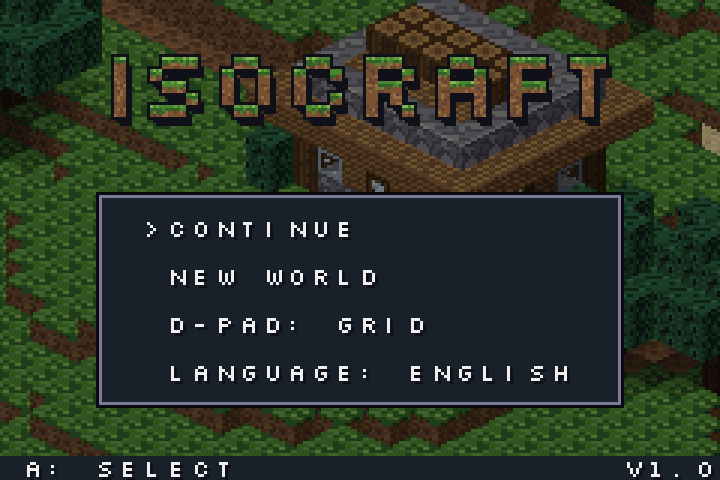
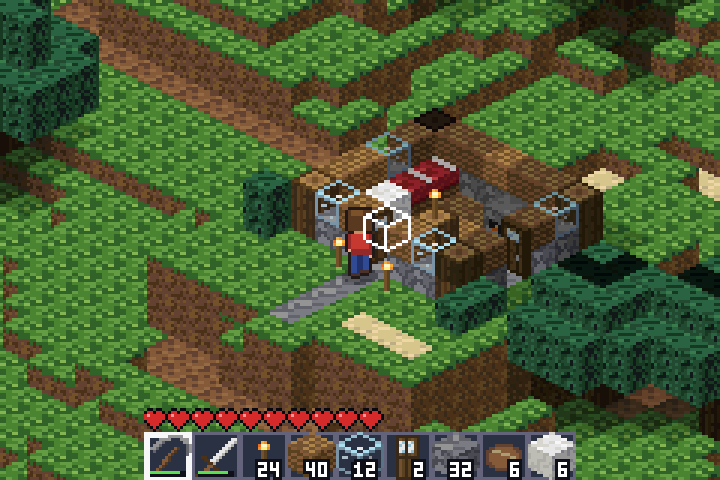
ISOCRAFT is an isometric block-building sandbox written for the Game Boy Advance. You arrive on the shore of a lake with nothing in your hands. You have about five minutes of daylight. What you make of the land is the game.
Hands, wood, stone, iron
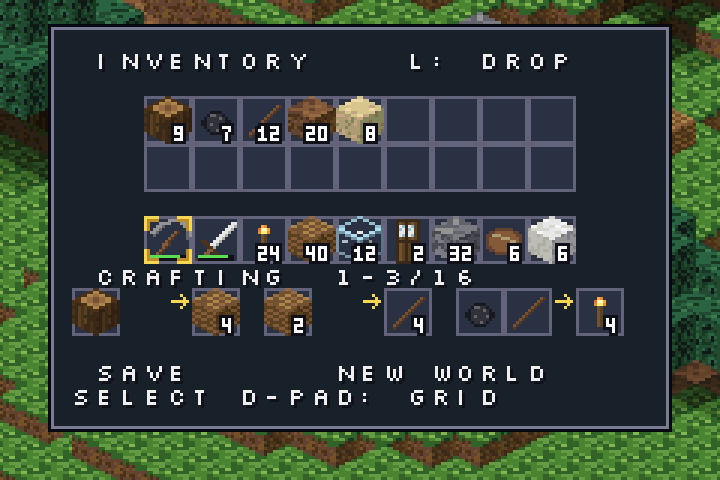
Fists take a tree apart. Logs become planks, planks become sticks, and the two together become a wooden pickaxe — the first thing that can open stone. Stone gives a better pickaxe, that pickaxe opens iron, and iron smelted in a furnace gives the best tools the land has. Nothing is unlocked by a menu; the land simply refuses you until you have the right thing in your hand.
- Sixteen recipes: tools, torches, a furnace, chests, doors and a bed, plus three that only appear with a furnace close by — iron, cooked meat and glass.
- Tools wear out. 59, 131 or 250 uses for wood, stone and iron, with a bar under the icon that runs from green to red.
- Digging takes time, and the cursor cracks as it goes. Without a pickaxe, stone takes a long time and gives nothing.
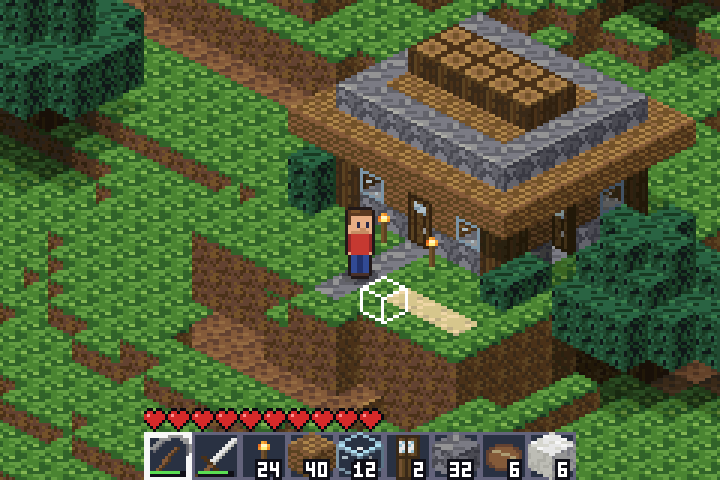
Build a house. Keep the night out.
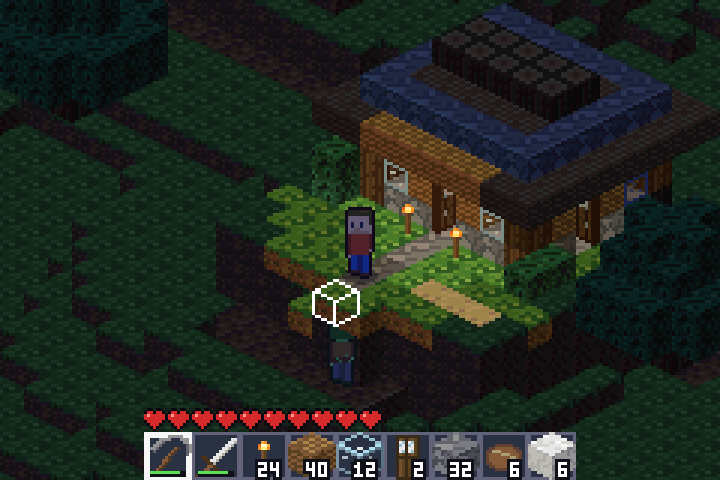
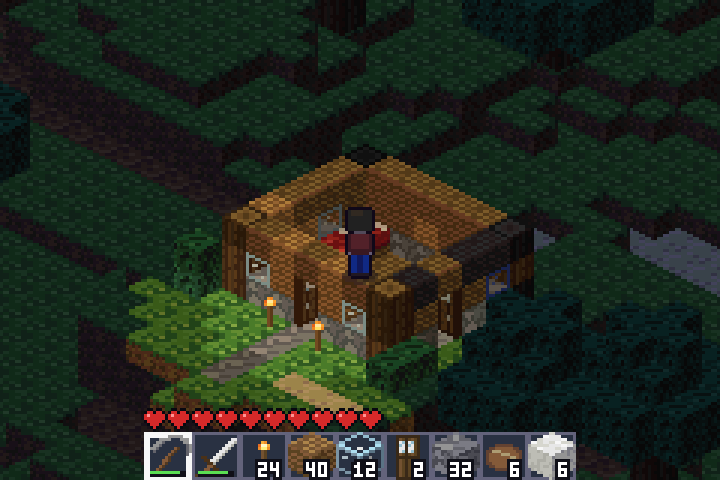
A day lasts ten minutes: five of sun, a sunset that turns the land orange and mauve, three of blue moonlit night and a pink dawn. When the light goes, the dead come out of the places it does not reach. Three things are true of them, and the whole of surviving is these three things:
- They never rise within reach of a torch. Light a room and nothing will ever appear inside it.
- They burn in direct sun. Morning ends every night.
- They cannot open a door. Four walls, a roof and a door you close behind you are a house.
Doors are two blocks tall and swing open edge-on to the wall. Glass windows let you see the room from outside and the night from in, and let torchlight through. A bed sets where you wake up and, at night, sleeps you through to morning — unless something is within ten blocks of you. Chests keep eighteen slots each, sixteen of them, saved with the world.
By day, pigs and sheep wander the grass in full sun. Pigs are meat. Sheep are wool, and wool is a bed.
A land the cartridge remembers
The world is grown from a seed, so it costs nothing to keep. What the cartridge keeps is a ledger of every block you have moved — up to 7,900 of them, four bytes each — along with every chest, every item lying on the ground, your tools and their wear, your bed, and the time of day. Walk away and the land behind you is forgotten and grown back from the seed, except for what the ledger says you changed. Come back and your house is still there.
What the hardware is doing
The picture is drawn by the processor. The Game Boy Advance has no 3D hardware and no idea what a cube is. Its background is a grid of 8 × 8 tiles, and every tile on screen here is composed in software: the few cubes that can touch it are walked from front to back against a 64-bit coverage mask, and the walk stops the moment the tile is full. About 4,200 cycles a tile, in ARM code running from the console's fast internal memory. The hardware scrolls; only the strip of tiles entering the screen is ever drawn.
A big land in a small window. 512 × 512 × 32 blocks, of which 64 × 32 × 64 — 128 KB — are in memory at once. Walk away from the middle and the window slides eight columns, growing the new strip in the background while you play.
Light is a palette. Every colour exists four times, at four levels of light, so lighting a block is choosing which copy to draw it with. Torchlight floods through air, water, glass and open doors, never through walls. Sunset is those copies being rewritten a little every few frames.
Being behind something. A second layer above you carries only the pixels of the cubes in front of you, so a tree hides you exactly where it should. Each creature carries its own small window of what stands in front of it and is cut out pixel by pixel. If you are more than half hidden, you are drawn as a ghost over everything, so you never lose yourself.
It runs at 60 frames a second. A scripted run through sunset into the night, with up to six creatures on screen and the world streaming under it, averages a quarter of the frame and never drops one.
Two renderers that must agree
The same C code is compiled for the desktop and drawn three ways: the fast incremental way the console uses, every tile from scratch, and a plain back-to-front painter that knows nothing about masks. Scrolling, digging, torches, water, glass, doors, all four camera angles and the sliding window are checked against both, pixel by pixel, on every build. A wrong pixel is a failed build.
Specifications
| Platform | Nintendo Game Boy Advance (also GBA SP, Micro, and the DS's GBA slot) |
| Cartridge | 141 KB ROM, 32 KB battery-backed SRAM |
| World | 512 × 512 × 32 blocks, 64 × 32 × 64 in memory |
| Languages | English and Spanish, chosen on the title screen |
| Built with | C and a little assembly, ARM GCC, no SDK |
Controls
| D-Pad | Walk (one-block steps are climbed on their own) |
| A | Jump, or swim up |
| B | Hit; hold to dig the block under the cursor |
| R | Open a chest, sleep, open or close a door; otherwise place or eat what is in your hand |
| L | Next hotbar slot; in the menu, throw the stack under the cursor |
| Select | Turn the camera a quarter turn |
| Start | Inventory and crafting |
In the download
- isocraft.gba — 141 KB Game Boy Advance ROM with battery save
- ISOCRAFT_Manual.pdf — 17-page digital instruction booklet, in the style of the ones that came in the box: the lore of the Square Land and its Ledger, getting started, controls, how to read the screen, every block with its digging time and what it gives, tools and their wear, all sixteen recipes, day and night and how light works, the three creatures, building a home, the builder's notes for the first night, and a technical dossier on how the cartridge does what it does
- Collectible card 06 — the ISOCRAFT card of the Eris Games series, with the shared back; the foil printing comes with any payment from $2
Credits
Design, code, art and sound: Eris Games
All in-game art, code, sound and text were written by hand.
Nintendo and Game Boy Advance are trademarks of Nintendo Co., Ltd. Eris Games is an independent studio and is not affiliated with, sponsored by or endorsed by Nintendo.
Purchase
In order to download this game you must purchase it at or above the minimum price of $1 USD. You will get access to the following files:
Comments
Log in with itch.io to leave a comment.
daaaamn this looks cool
looks sick!